

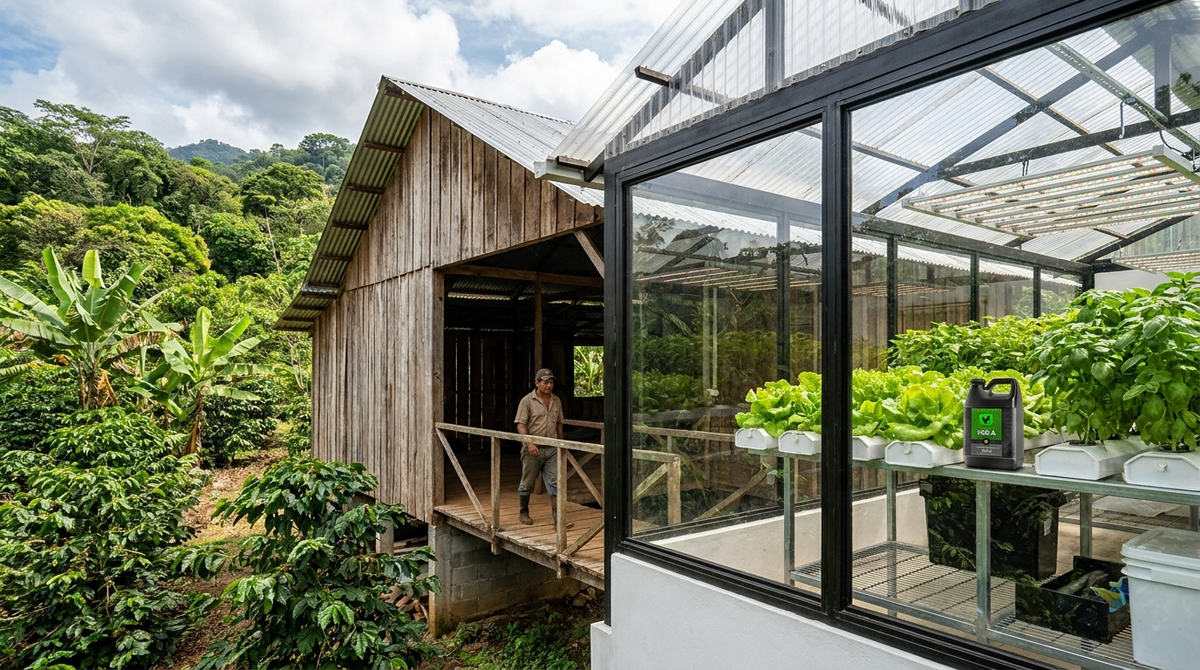
Costa Rican farms and ranches are facing pressures today that their founders never imagined: increasingly unpredictable weather, volatile commodity prices, rising input costs, and competition from low-cost imports. Controlled indoor farming – specifically hydroponics – is emerging as a complementary solution: not to replace the traditional farm, but to diversify it with a high-value production segment that is not dependent on weather or commodity cycles.
Why Farms in CR Are Ideal Candidates for Indoor Cultivation
- Existing infrastructure: Farms already have access to water, electricity, and spaces that can be adapted. An underutilized shed, a warehouse, or a covered area are perfect starting points.
- Workforce: Farms with their own staff can absorb indoor cultivation work without significant additional cost in the initial cycles.
- Market access: Many farms already have established commercial relationships with markets, restaurants, or distributors that can serve as sales points for hydroponic produce.
- Own water source: Many farms have springs or wells, which reduces the cost of irrigation water and eliminates dependence on the public water supply.
Most Successful Integration Models
Complementary Hydroponic Greenhouse
The most common model. A 100-500 m2 greenhouse installed on the farm, with NFT systems for lettuces and herbs, and DWC or coco for tomatoes and cucumbers. Production is integrated into the farm's existing sales flow or channeled separately as a premium line.
Processing and Value Added
Farms with fruit or tuber production can add a line of fresh hydroponic vegetables to offer mixed boxes that combine field production with premium hydroponic vegetables. This model increases the average ticket of each existing customer.
Agro-tourism with a Hydroponic Component
For farms oriented towards agro-tourism, a visually striking hydroponic component — such as a vertical green wall with herbs or a lettuce NFT system — adds an educational attraction for visitors and an additional source of income.
Production for the Farm Itself
Some coffee or cattle farms establish hydroponic subsistence crops to supply staff with fresh vegetables, reducing cafeteria costs and improving the team's well-being.
Recommended Crops by Farm Type
| Farm type | Recommended hydroponic crop | System | Advantage |
|---|---|---|---|
| Coffee farm (high altitude) | Lettuces, spinach, strawberries | NFT / Coco | Ideal cool temperatures |
| Cattle farm (low altitude) | Aromatic herbs, microgreens | NFT / Trays | High demand in tourist areas |
| Fruit farm (any zone) | Cherry tomatoes, cucumbers | Coco / DWC | Portfolio complement |
| Tourist farm (near beach) | Herbs, lettuces, microgreens | NFT | Nearby hotels and restaurants |
How to Adapt Existing Farm Spaces
Sheds and Warehouses
The metal or block sheds that many CR farms have semi-utilized are perfect candidates for an indoor setup. With reflective white walls, ventilation ducts, and high-efficiency LEDs, a 10x10 meter shed can be converted into a high-yield hydroponic production area with reasonable investment.
Existing Rustic Greenhouses
Many farms already have greenhouse structures with plastic or mesh. Adding an NFT system inside an existing greenhouse is the most economical way to enter protected cultivation. The advantage: the greenhouse already filters wind and direct rain. For greater temperature and HR control, add forced ventilation and a dehumidifier in critical months.
New Specialized Facilities
For farms that want a serious hydroponic production line from the start, building a specific space is the best option. A 50-100 m2 module with a concrete floor, reflective walls, controlled ventilation system, and three-phase electricity is the industry standard for commercial farms in CR.
Water Management: The Advantage of Farms in CR
One of the great advantages of farms is access to their own water. For hydroponic cultivation, there are important considerations:
- Water analysis: Before using farm water for hydroponics, analyze it to determine baseline TDS, pH, and potential contaminants. In CR, well water in volcanic areas can be very alkaline (pH 7.5-8.5).
- Basic filtration: A sediment filter and an activated carbon filter are sufficient for most farm water sources. For very low-quality water, consider reverse osmosis.
- Storage: A 500-1000 liter reserve tank allows for pre-mixing the nutrient solution and maintaining a stable water temperature before irrigation.
Case Study: Coffee Farm + Hydroponic Greenhouse
A real scenario we are seeing in Costa Rica: coffee farms in the Grecia, Naranjo, and San Ramón areas that are adding 50-80 m2 hydroponic modules to produce lettuces, herbs, and cherry tomatoes. The reasons:
- Coffee prices have high volatility. A premium vegetable line with more stable prices is a natural income hedge.
- The coffee harvest period is seasonal. Staff can dedicate time to hydroponic cultivation during inter-harvest periods.
- High-altitude water (coffee growing areas) is of excellent quality for hydroponics: cold, clean, and low in salts.
- Coffee distribution channels can be expanded to include premium vegetables with little additional friction.
Frequently Asked Questions
- Do I need special permits to install a hydroponic greenhouse on my farm in CR?
- In most cases, not for small or temporary structures. For larger permanent structures, consult with the municipality. SENASA has registration requirements if you are going to commercialize formally as an agricultural producer.
- How much water does hydroponics use compared to field cultivation?
- Recirculating hydroponic systems use up to 90% less water than field cultivation for the same yield. For farms with water restrictions in summer (like Guanacaste), this efficiency is a significant advantage.
- Can hydroponic production be certified as organic in CR?
- In Costa Rica, SENASA organic certifications were designed for soil cultivation. However, systems with organic substrates such as coco and vermicompost can opt for BPA (Good Agricultural Practices) certifications, which are well-accepted in supermarkets and hotels.
Conclusion
Indoor hydroponic cultivation does not compete with the traditional farm – it complements it. Farms that integrate hydroponic production will be better positioned against price volatility, climate change, and the growing local market demand for quality fresh vegetables. The Costa Rica Hydroponics team is available to advise on the design and integration of the most suitable hydroponic system for your specific farm.


