

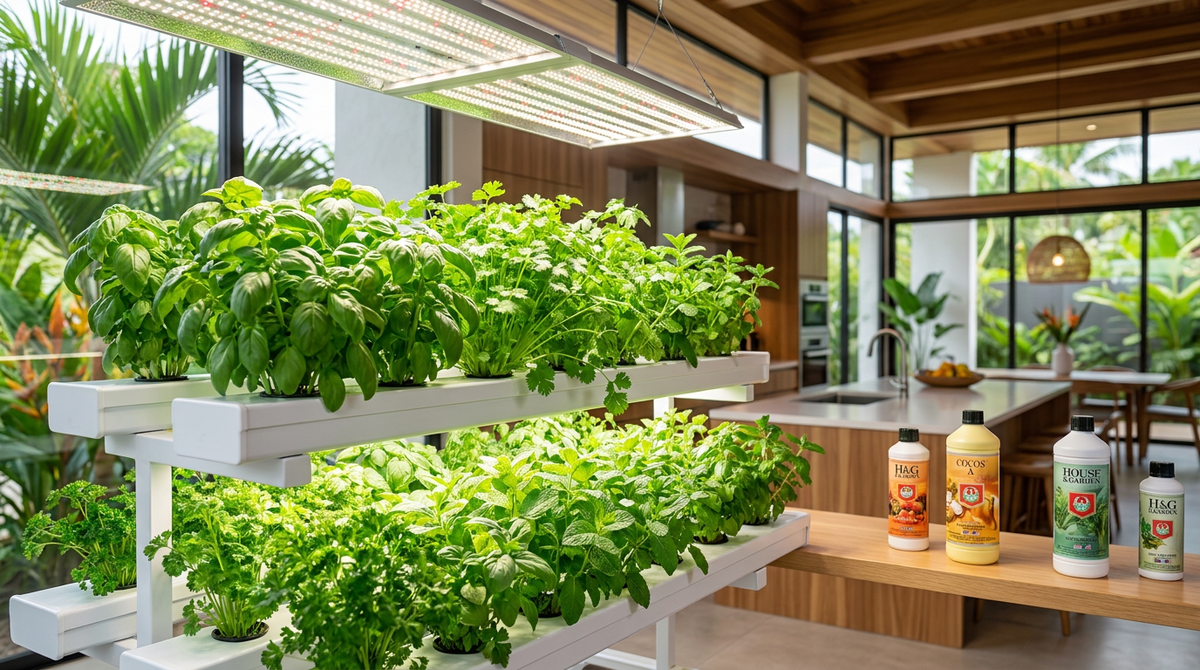
Imagine having fresh cilantro, basil, mint, and oregano available every day, without relying on the supermarket, without pesticides, and with twice the aroma and flavor of store-bought herbs. That's exactly what hydroponic herb cultivation offers in Costa Rica — and it can be achieved in a space of less than 1 square meter.
This guide is designed for both households that want fresh herbs in the kitchen and for restaurants, hotels, and food service businesses looking for a reliable and economical source of quality herbs in Costa Rica.
Why Do Herbs Grow Better in Hydroponics?
Aromatic herbs are among the crops that benefit most from the hydroponic system. In soil, a basil plant can take 30-40 days to be ready for harvest. In a well-managed NFT system, the same cycle can be reduced to 18-25 days. The reasons are simple:
- Direct access to nutrients: Without the mediation of the substrate, roots absorb exactly what they need when they need it.
- Constant oxygen: In NFT, part of the roots is exposed to the air — the same principle that makes aeroponic systems so efficient.
- No weeds or soil pests: Eliminates fungus gnats, nematodes, and other soil pests that attack roots in soil.
- Continuous harvest: In hydroponics, you can harvest by cutting (cut-and-come-again) without uprooting the plant. The same plant produces for weeks.
The Best Systems for Aromatic Herbs
NFT (Nutrient Film Technique)
The ideal system for herbs. Inclined channels with a thin film of nutrient solution flowing continuously. Excellent for medium-sized plants like basil, mint, sage, thyme, and oregano. 2-inch net pots are perfect for this system.
For a restaurant, a 4-channel, 1.2-meter NFT system can produce up to 48-64 plants simultaneously — enough to cover the fresh herb needs of a medium-sized establishment.
Small DWC (Kratky Method)
The simplest version of static hydroponics, without a pump. The plant floats in a container with nutrient solution and takes what it needs. Perfect for home use: low cost, no additional electricity for the pump, and excellent for cilantro, parsley, and slow-growing herbs.
Coco System with Drip Irrigation
For woody herbs like rosemary, sage, and thyme that prefer a more structured substrate. Coco coir with automatic irrigation every 2-4 hours yields excellent results with varieties that do not tolerate fully submerged roots well.
The Best-Growing Hydroponic Herbs in CR
| Herb | Recommended system | Optimal pH | Target EC | Time to harvest |
|---|---|---|---|---|
| Basil | NFT / DWC | 5.5 - 6.5 | 0.8 - 1.6 | 18-25 days |
| Cilantro | NFT / Kratky | 6.0 - 7.0 | 0.8 - 1.4 | 20-30 days |
| Mint | NFT / DWC | 5.5 - 6.5 | 1.0 - 1.6 | 25-35 days |
| Parsley | NFT / Kratky | 6.0 - 7.0 | 0.8 - 1.4 | 30-40 days |
| Oregano | NFT / Coco | 6.0 - 7.0 | 0.8 - 1.4 | 35-50 days |
| Thyme | Coco | 5.5 - 7.0 | 0.8 - 1.6 | 40-60 days |
Nutrients for Herbs: Less is More
The most common mistake when growing herbs hydroponically is overfeeding them. Aromatic herbs prefer a low EC (0.8 - 1.4 mS/cm). Too high an EC produces plants with excess nitrogen: large, dark green leaves, rapid growth, but with fewer essential oils and reduced aroma. For culinary quality herbs, lower EC = higher flavor concentration.
Nutrient lines that work best for herbs in CR:
- Athena Pro Grow + Core at low doses: 4-5 g/gal Grow + 0.5 g/gal Core. Perfect for those who already use Athena for other crops.
- Canna Coco A+B at 2-3 ml/L: Canna's Coco line is specially formulated for closed systems like NFT/DWC.
Recommended Setup for Restaurants in Costa Rica
For a restaurant that consumes fresh herbs daily, this is the minimum setup to become independent from suppliers:
- 6-channel NFT system x 1.5m: Capacity for 72-96 simultaneous plants in rotation
- 100-150W real full spectrum LED: Sufficient for the system's footprint
- Low-consumption pump + timer: For automatic irrigation cycle
- pH meter + EC meter: Essential for weekly maintenance
- Nutrients for 6 months: With low EC, consumption is minimal and economical
A system of this size can produce 2-3 kg of fresh herbs per week in continuous rotation, at a fraction of the cost of buying them on the market.
Adjustments for CR's Tropical Climate
In Costa Rica, the main challenge with herbs is heat and humidity. In the rainy season, high HR (80-95%) can favor fungi on basil and cilantro leaves.
- Constant air circulation: An oscillating fan is sufficient for small systems. Air movement dries leaves and strengthens stems.
- Frequent harvesting: Do not let herbs grow too dense. Regular harvesting improves internal circulation and reduces the risk of fungi.
- Water temperature: In hot areas of CR (above 28°C), change the tank more frequently or use a small chiller to keep the solution fresh.
Hydroponic Herbs as a Business in CR
The fresh aromatic herb market in Costa Rica is undersupplied and fragmented. Most restaurants buy variable quality herbs at high prices. A hydroponic herb micro-farm can position itself as a premium supplier with direct deliveries to businesses. With a 20-30 m2 setup, 15-25 kg of premium fresh herbs can be produced per week, with an attractive return at local market prices (₡500-1,500 per 100g).
Frequently Asked Questions
- Can I grow cilantro hydroponically all year round in CR?
- Yes. Indoor hydroponic cilantro is not limited by season. The only challenge is heat: above 28°C, cilantro tends to bolt faster. With good ventilation, production is constant all year.
- Are hydroponic herbs tastier than soil-grown ones?
- Herbs with controlled EC and harvested at the optimal time can be more aromatic than those bought in supermarkets (which reach the consumer several days after harvest). Low EC concentrates the essential oils responsible for aroma.
- Do I need artificial light if I have a large window?
- A very bright window can be sufficient for low-requirement herbs like mint and parsley. For high-production basil and cilantro, a supplementary 50-100W LED significantly improves results, especially in the rainy season when cloudy days are the norm.
- Where can I get NFT systems and nutrients in Costa Rica?
- At Costa Rica Hydroponics, you have access to NFT systems, channels, net pots, Athena and Canna nutrients, and everything you need to start your herb farm today, with shipping nationwide.
Conclusion
Aromatic herbs are the perfect entry point to hydroponics in Costa Rica: low initial cost, quick return, and a product with guaranteed demand for both personal use and businesses. If you already have a small indoor space and a light source, you can have your first harvest of hydroponic herbs in less than 30 days.


