

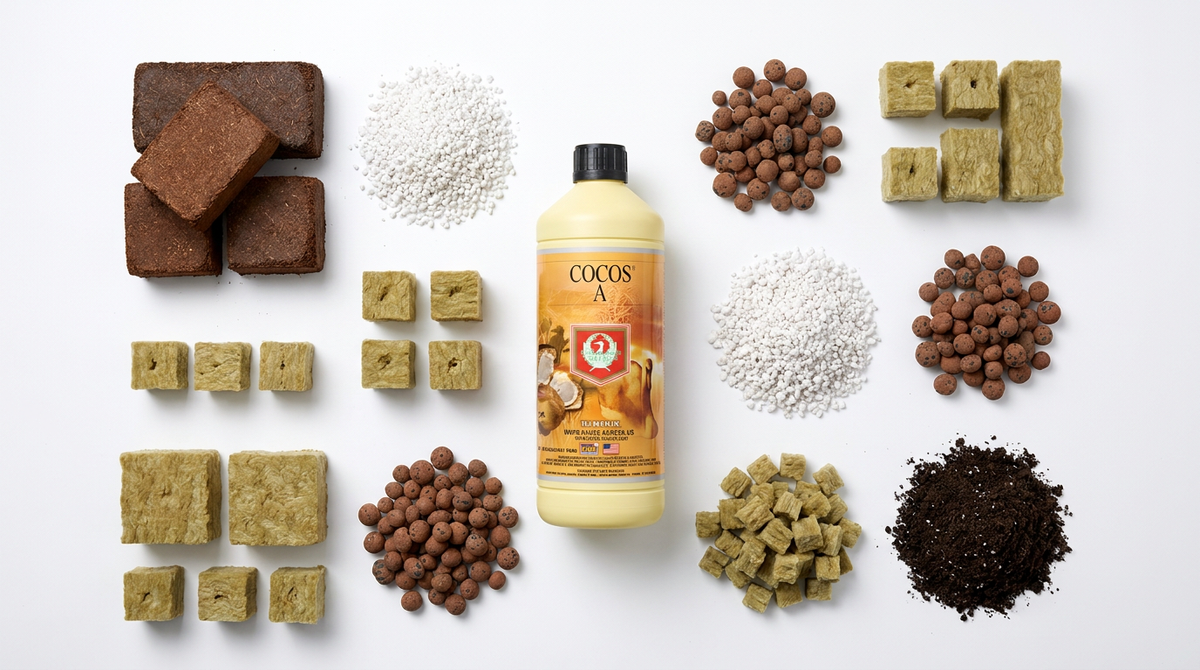
The substrate is home to the roots. Everything else in cultivation—light, nutrients, climate—is of little use if the roots are not in a medium that properly supports, nourishes, and oxygenates them. In Costa Rica, choosing the right substrate must also consider the tropical climate: high temperatures, high humidity, and alkaline irrigation water are variables that affect how each substrate performs.
This comprehensive guide compares the most common indoor cultivation substrates in CR, their real advantages and disadvantages, and when to use each one.
What Makes a Good Substrate for Indoor Cultivation?
A high-quality indoor cultivation substrate must fulfill five functions:
- Physical support: Holding the plant upright throughout its cycle.
- Water retention: Maintaining enough moisture between irrigations so that the roots do not dry out.
- Adequate drainage: Quickly removing excess water to prevent root asphyxiation.
- Aeration: Maintaining air pores for roots to breathe.
- Stable pH: Not significantly altering the pH of the nutrient solution.
The 6 Most Used Substrates for Indoor Cultivation in Costa Rica
1. Coconut Coir
The star substrate of modern cultivation. Produced from processing coconut husks, coconut coir has ideal properties for intensive cultivation:
- Water retention: High (retains 8-10x its weight in water)
- Aeration: Excellent (30% air porosity even when saturated)
- Natural pH: 5.5-6.5 (ideal for most crops)
- Reusable: Yes, with washing and reconditioning between cycles
Coir comes in different forms: chips (coarse coir for greater aeration), fine powder (better retention), and blends. For most crops in CR, a 70% powder / 30% chips blend is the optimal balance.
The only special consideration for coir: it has a high affinity for calcium and magnesium (it absorbs and retains them), so it is essential to use nutrients formulated for coir (like Canna Coco A+B) or add sufficient CalMag with any other line.
2. Perlite
Volcanic glass expanded at high temperature, inert and lightweight. Perlite alone retains almost no water or nutrients—its function is to add aeration and drainage to any mix.
- Typical use: Mixed with coir (20-30%) or organic soil (25-40%) to improve drainage
- Advantage in CR: During the rainy season, when humidity keeps substrates wetter than usual, more perlite in the mix is an advantage to prevent overwatering
- pH: Neutral, does not affect substrate pH
Important tip: washing perlite before use removes silica dust that can clog drippers and is irritating to the lungs.
3. Organic Soil (Potting Mixes)
Soil is the most familiar substrate and, when chosen well, produces excellent results, especially with organic nutrient programs like Gaia Green. Commercial soils in Costa Rica vary enormously in quality.
What to look for in soil for indoor cultivation in CR:
- pH between 6.0 and 7.0
- Visible components of organic matter (worm castings, compost)
- Loose texture that does not compact in the pot
- No excess fine sand that reduces aeration
Recommended mix for cultivation in CR with soil: 50% good quality soil + 30% perlite + 20% worm castings. This mix balances retention, drainage, and beneficial microorganisms.
4. Rockwool
Mineral fiber derived from molten volcanic rock. The standard substrate in commercial hydroponics and professional propagation.
- Advantages: Sterile (pathogen-free), excellent aeration, available in small cubes (for clones/seeds) and large blocks (for adult plants)
- Disadvantages: Not reusable, problematic disposal (not biodegradable), requires pH pre-conditioning before use (soak in pH 5.5 water for 24 hours)
- Use in CR: Very popular in propagation (1x1 inch cubes for rooting clones) and as the main substrate in commercial NFT and Ebb&Flow systems
5. Hydroton / LECA (Expanded Clay)
Expanded clay balls at high temperature. Completely inert, with excellent drainage and aeration. Used in DWC, Ebb&Flow systems, and as a bottom drainage layer in pots with other substrates.
- Advantage: Indefinitely reusable (clean and sterilize between cycles)
- Disadvantage: Does not retain water—roots need frequent contact with the nutrient solution (not suitable for infrequent irrigation)
- Recommended use: First 2-3 cm of the pot bottom (prevents drainage obstruction) + in flood/drain systems where the substrate is regularly saturated
6. Peat Moss
Decomposed moss with excellent water retention and low pH (3.5-4.0). Always used in mixes, never alone.
- Typical use: Component of seedling and propagation mixes (mixed with perlite 50/50)
- Environmental consideration: Peat moss comes from peat bogs that take thousands of years to form. For sustainable organic cultivation, many growers prefer coir as a more sustainable alternative
Substrate Comparison Table
| Substrate | Water retention | Aeration | Natural pH | Reusable | Relative cost | For beginners |
|---|---|---|---|---|---|---|
| Coconut coir | High | Excellent | 5.5-6.5 | Yes | Medium | Yes |
| Perlite (alone) | Very low | Excellent | Neutral | Yes | Low | No (alone) |
| Organic soil | High | Medium | 6.0-7.0 | Partial | Low | Yes |
| Rockwool | Good | Excellent | 7.0 (pre-condition) | No | Medium | With guidance |
| Hydroton/LECA | Very low | Excellent | Neutral | Yes | Medium | No (alone) |
Most Effective Mixes for Costa Rica
In CR, the mixes that work best considering the tropical climate and local water characteristics:
- For coir cultivation with synthetic nutrients (Athena, Canna Coco): 70% coir powder + 30% coir chips. Multiple daily irrigations.
- For organic cultivation with Gaia Green: 40% soil + 20% perlite + 20% worm castings + 15% coir + 5% coarse perlite.
- For propagation (clones and seeds): 50% peat moss + 50% perlite, or pre-conditioned rockwool cubes.
- For NFT and DWC systems: Rockwool cubes in net pots, or only hydroton/LECA if constant moisture is guaranteed.
- For large pots with infrequent irrigation: 60% soil + 30% perlite + 10% worm castings. The higher percentage of perlite ensures drainage in CR where environmental humidity reduces evaporation.
Frequently Asked Questions
- Can I reuse coir from one cycle to the next?
- Yes, coir can be reused 2-4 cycles if properly washed between uses. The process: washing with pH 5.5-6.0 water to remove accumulated salts, followed by a light 0.5% hydrogen peroxide solution for sterilization, and a new charge of starter nutrients.
- What substrate do you recommend for the first cultivation in CR?
- For beginners, good quality organic soil mixed with 30% perlite is the most forgiving option. It has a natural buffer, is cheaper, and pH or EC errors are more easily absorbed. Once experienced, migrating to coir is the natural next step towards greater control and growth speed.
- Is CR coir the same as imported coir?
- Quality coir (like Canna Coco) undergoes a specific washing process that removes tannins and excess sodium naturally present in raw coir fiber. Unprocessed or low-quality coir can alter pH and contain pathogens. Always verify that the coir you buy is treated and certified for hydroponic cultivation.
Conclusion
Choosing the right substrate is one of the most important decisions you make before starting your grow. There is no universally perfect substrate—there is the right substrate for your system, your nutrients, your crop, and your conditions in Costa Rica. The important thing is to understand the properties of each and make an informed choice that complements the rest of your setup.


