

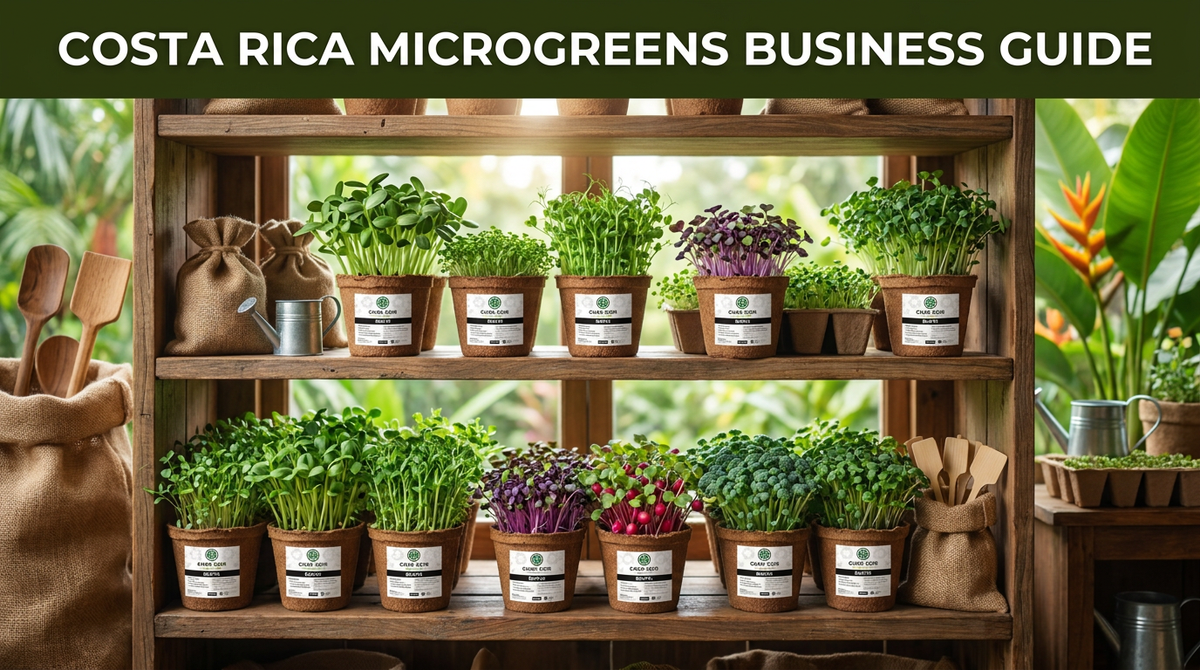
If you had to choose a single crop to maximize return per square meter in the shortest possible time, microgreens would be the almost universal answer. With cycles of 7 to 14 days, prices ranging from ₡2,000 to ₡8,000 per 100 grams in Costa Rica, and a rapidly growing market among gourmet restaurants, hotels, and nutrition-conscious consumers, microgreens represent an unparalleled business opportunity in CR's indoor farming scene.
What Exactly Are Microgreens?
Microgreens are young seedlings harvested just after the first true leaves (cotyledons) appear. They are not sprouts (which are harvested earlier), nor baby greens (which are harvested later). They are at the exact point where nutrient concentration and flavor reach their peak, before the plant begins to allocate energy to vegetative growth.
Aesthetically, microgreens are one of the most visually striking elements in contemporary cuisine. Chefs use them as a garnish, a main ingredient in salads, and as bursts of flavor and color in gourmet presentations.
Why Microgreens Are the Ideal Crop for CR
- Ultra-short cycle: 7-14 days from sowing to harvest. In one month, you can complete 2-4 harvests from the same space.
- No complex hydroponic system: Microgreens are grown in shallow trays with a thin layer of substrate or on jute/hemp mats. Initial investment is minimal.
- Minimal space: A 4-tier shelving unit (1m x 0.5m per tier) can produce 8 trays simultaneously. With rotational cycles, that's 20-30 trays per month.
- High unmet demand in CR: Quality microgreens are difficult to find in Costa Rica. Most restaurants that want them either import them or go without.
The Most Profitable Microgreens for the CR Market
| Species | Cycle (days) | Flavor | Est. CR Price (/100g) | Difficulty |
|---|---|---|---|---|
| Radish | 5-7 | Spicy, fresh | ₡2,000 - 3,500 | Very easy |
| Sunflower | 8-12 | Mild, nutty | ₡2,500 - 4,000 | Easy |
| Pea | 10-14 | Sweet | ₡2,500 - 4,500 | Easy |
| Broccoli | 7-10 | Mild, nutty | ₡3,000 - 5,000 | Easy |
| Mustard | 6-9 | Intensely spicy | ₡2,000 - 3,500 | Easy |
| Beetroot | 10-14 | Earthy, sweet | ₡3,500 - 6,000 | Moderate |
| Amaranth | 8-12 | Mild, sweet | ₡4,000 - 7,000 | Moderate |
| Cilantro | 14-21 | Intensely cilantro | ₡4,000 - 8,000 | Moderate |
Microgreens Production Setup in CR
Minimum Equipment to Start
The barrier to entry for microgreens is the lowest of any indoor crop:
- Standard 10x20 inch trays: Germination trays with and without drainage holes (used in pairs)
- Substrate: Light germination mix (peat + perlite or fine coco coir), or jute or hemp growing mats for soilless cultivation
- Low-power LEDs: 40-60W actual per shelf level. Microgreens don't need the light intensity of mature plants
- Metal shelving unit: Any adjustable 4-5 tier shelving unit
- Spray bottles: For gentle spray irrigation in the early stages
- Quality seeds: The most critical input. Specific microgreen seeds with guaranteed high germination
Initial Setup Cost (Small Production)
| Equipment | Quantity | Est. CR Cost |
|---|---|---|
| Germination trays | 20 pairs | ₡20,000 - 35,000 |
| Growing mats | 20 units | ₡15,000 - 25,000 |
| Grow LEDs (2 shelving units) | 2 units | ₡30,000 - 55,000 |
| Metal shelving unit | 2 units | ₡20,000 - 35,000 |
| Initial seeds (mix 5 species) | 500g each | ₡25,000 - 45,000 |
| Initial substrate | 50 liters | ₡8,000 - 15,000 |
| Total | ₡118,000 - 210,000 |
The Step-by-Step Growing Process
- Seed soaking (optional depending on species): Large seeds like sunflower and pea are soaked 8-12 hours before sowing. Radish, broccoli, and mustard do not need soaking.
- Tray preparation: Fill the tray with 2-3 cm of moist (not saturated) substrate or place the moistened growing mat.
- Sowing: Distribute seeds evenly, in a single layer without excessive overlap. Ideal density varies by species.
- Darkness phase (blackout, 2-5 days): Place an empty tray on top as a lid, creating weight and darkness. This stimulates initial stretching towards light and produces stronger stems.
- Uncover and expose to light: When stems are 2-3 cm, remove the cover and place under LEDs. Water from below (by putting water in the outer tray) to avoid wetting the leaves.
- Harvest: When cotyledons are open and before the first true leaves appear. Cut with clean scissors just above the substrate.
Selling Microgreens in Costa Rica: The Most Receptive Market
The sales channels for microgreens in CR are clear and accessible:
- Gourmet restaurants: The ideal customer. In the GAM (Greater Metropolitan Area), there are dozens of restaurants that already know and want microgreens but lack a reliable local supplier. A personal visit with a sample is all you need to close the first customers.
- Boutique hotels and resorts: Design hotels in Guanacaste, Manuel Antonio, and the GAM have budgets for premium ingredients and value local production.
- Farmers' markets and green fairs: Green fairs in San José, Escazú, and other cities have consumers with high purchasing power and willingness to pay for premium local produce.
- Vegetable subscription boxes: Adding microgreens to a weekly vegetable box increases the average ticket and differentiates the product.
Frequently Asked Questions
- Do I need prior growing knowledge to produce microgreens?
- No. Microgreens are the indoor crop with the lowest learning curve. The process is simple, fast, and mistakes are corrected in the next cycle (7-14 days later). It's the ideal crop to start growing and selling without prior experience.
- How much can I earn producing microgreens in CR?
- A 4-tier shelving unit with 8 active trays can produce 1.5-2 kg of mixed microgreens per week. At an average of ₡3,500 per 100g, that's ₡52,000 - 70,000 per week in gross sales. With 2-3 shelving units, the potential exceeds ₡200,000 in monthly income.
- How many times can I reuse trays and mats?
- Plastic trays last for years with care. Jute or hemp mats are single-use (composted with the roots). Mineral substrate (perlite + coco) can be reused 2-3 times with washing between cycles.
Conclusion
Microgreens are the perfect crop for anyone who wants to enter the world of premium food production in Costa Rica with minimal investment and maximum potential return. Whether as a complement to another crop, as a source of household income, or as the core of a commercial microfarm, microgreens deserve a place in any indoor growing plan in CR.


