

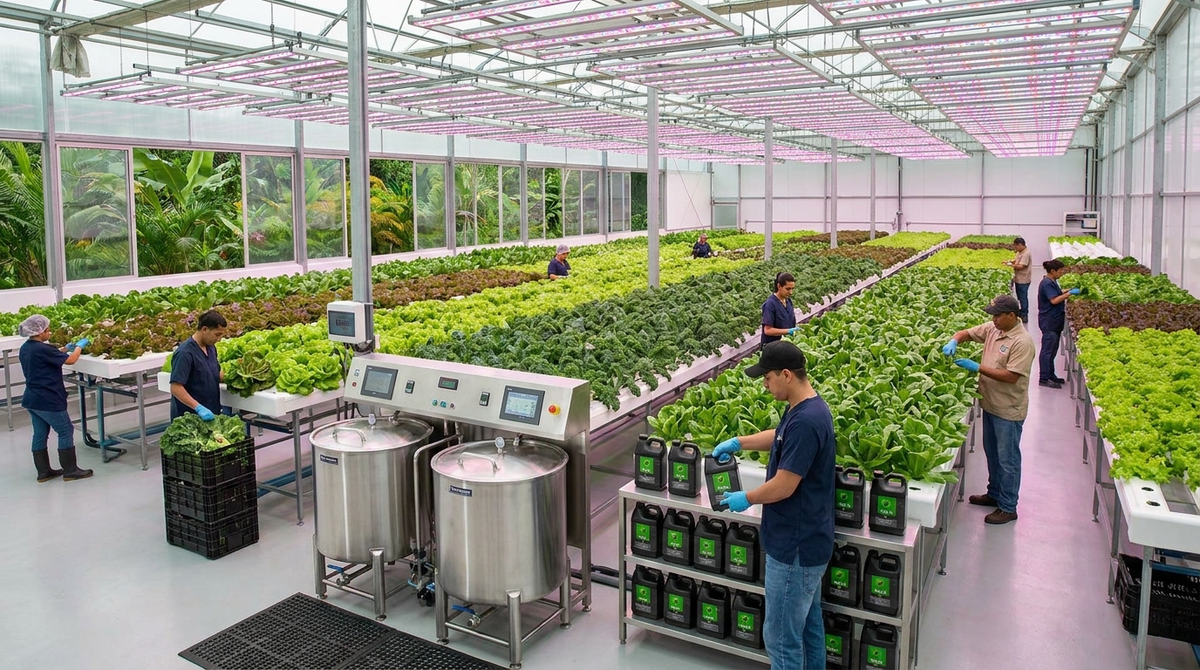
The most frequent question we receive from entrepreneurs and business owners in Costa Rica is the same: Is it worth investing in a commercial hydroponic farm? The honest answer is: yes, with the right conditions. But like any business, success depends on the model, execution, and sales strategy. This guide gives you the real numbers so you can evaluate it intelligently.
The Premium Vegetable Market in Costa Rica
The market context is favorable for hydroponic production in CR:
- Growth in premium vegetable consumption: The market for fresh, traceable vegetables is growing approximately 15-20% annually in the GAM.
- Reliance on imports: Costa Rica imports most premium lettuce, spinach, arugula, and aromatic herbs. There is a real niche for quality local production.
- Demanding tourism sector: 4 and 5-star hotels in Guanacaste, Manuel Antonio, and the Central Valley need consistent quality vegetables that they currently buy at high prices from importers.
- Expanding gourmet restaurants: San José, Escazú, Santa Ana, and Liberia have a growing gastronomic market with high demand for fresh local produce.
Business Models for a Commercial Hydroponic Farm in CR
Model 1: Specialized Micro-farm (20-50 m2)
Specialization in 2-3 high-value crops (herbs, premium lettuces, microgreens) with direct sales to restaurants and households. Specialization allows for mastering production and building direct relationships with high-value customers.
Model 2: Leafy Vegetable Farm for Retail (200-500 m2)
Mass production of lettuces, spinach, and leafy greens for supermarkets and gourmet stores. Requires greater investment, formal packaging, and consistent production capacity.
Model 3: Urban Vertical Farm (50-100 m2 vertically)
Vertical shelving with 4-6 levels in urban spaces. The value lies in proximity to the end consumer and the elimination of the distribution chain. A real opportunity for the GAM.
The Real Calculation: NFT Hydroponic Lettuce as an Example
Production Parameters
| Variable | Value |
|---|---|
| System | NFT, 10 channels of 3 meters |
| Simultaneous capacity | 240 plants |
| Production cycle | 35 days |
| Rotations per year | 10.4 |
| Annual production | 2,496 lettuces/year |
Revenue Scenario
| Sales channel | Unit price | Annual revenue (2,496 lettuces) |
|---|---|---|
| Restaurants and hotels (direct) | ₡1,800 - 2,500 | ₡4,492,800 - 6,240,000 |
| Farmers' markets | ₡1,200 - 1,800 | ₡2,995,200 - 4,492,800 |
| Gourmet supermarket | ₡900 - 1,400 | ₡2,246,400 - 3,494,400 |
Estimated Annual Costs
| Item | Estimated annual cost |
|---|---|
| Electricity (LED + extractor + pump) | ₡600,000 - 900,000 |
| Nutrients | ₡150,000 - 250,000 |
| Seeds / seedlings | ₡80,000 - 120,000 |
| Materials and substrate | ₡60,000 - 100,000 |
| Packaging and labeling | ₡100,000 - 180,000 |
| Labor (partial) | ₡600,000 - 1,200,000 |
| Total annual costs | ₡1,590,000 - 2,750,000 |
Margin Analysis
With sales to restaurants and hotels averaging ₡2,000 per lettuce, annual revenue with 10 NFT channels exceeds ₡4,900,000. Deducting costs of ₡2,200,000, the net margin is around 55-60%. Scaling to 40-50 channels (100 m2) multiplies these numbers by 4-5, with economies of scale in fixed costs like electricity and space.
Critical Factors Affecting Profitability
Electricity Cost
Electricity is the largest variable cost. ICE rates for residential vs. industrial use can vary significantly. For larger farms, exploring ICE's industrial T-IN rate, which has lower kWh costs for high consumption, is advisable.
Sales Channel
The difference between selling to supermarkets (low margins, 30-60 day payment terms) vs. selling directly to restaurants (better prices, immediate payment) can determine whether the business is viable. Building direct relationships with customers from the outset is the recommendation of almost all successful hydroponic farmers in CR.
Production Efficiency
The first 2-3 cycles always have lower production due to the learning curve. A 20-30% loss in the initial cycles is normal and should be considered in the initial business plan.
Initial Investment vs. Payback Period
| Size | Est. initial investment | Est. annual revenue | ROI time |
|---|---|---|---|
| Micro (20-25 m2) | ₡1,200,000 - 2,000,000 | ₡2,500,000 - 4,000,000 | 12-24 months |
| Small (50-80 m2) | ₡3,000,000 - 5,000,000 | ₡6,000,000 - 10,000,000 | 18-30 months |
| Medium (150-250 m2) | ₡8,000,000 - 15,000,000 | ₡15,000,000 - 25,000,000 | 18-24 months |
Frequently Asked Questions
- How long does it take for a hydroponic farm in CR to become profitable?
- With a well-executed sales strategy with direct customers, 20-50 m2 farms generally reach breakeven between month 6 and 12 of operation.
- Is it possible to do commercial hydroponics from home in CR?
- Yes, and it is the recommended strategy to reduce initial risk. Many successful growers in CR started in garages, terraces, or tool sheds. Permits depend on the municipality and production volume.
- Which crop maximizes ROI?
- Microgreens have the highest return per square meter (7-14 day cycles, prices of ₡2,000-5,000 per 100g). Aromatic herbs are the second best due to short cycles and premium prices. Lettuce is the most predictable and highest volume crop.
Conclusion
Commercial hydroponics in Costa Rica is a real opportunity. The market exists, the technology is accessible, and the margins are attractive for those who execute well. The key is to start at the right scale, build direct relationships with valuable customers, and reinvest profits to grow gradually. The Costa Rica Hydroponics team can advise you on the system design and business model best suited for your specific situation.


